
For commercial transport and logistics businesses, fleet safety involves more than simply tracking where vehicles are.
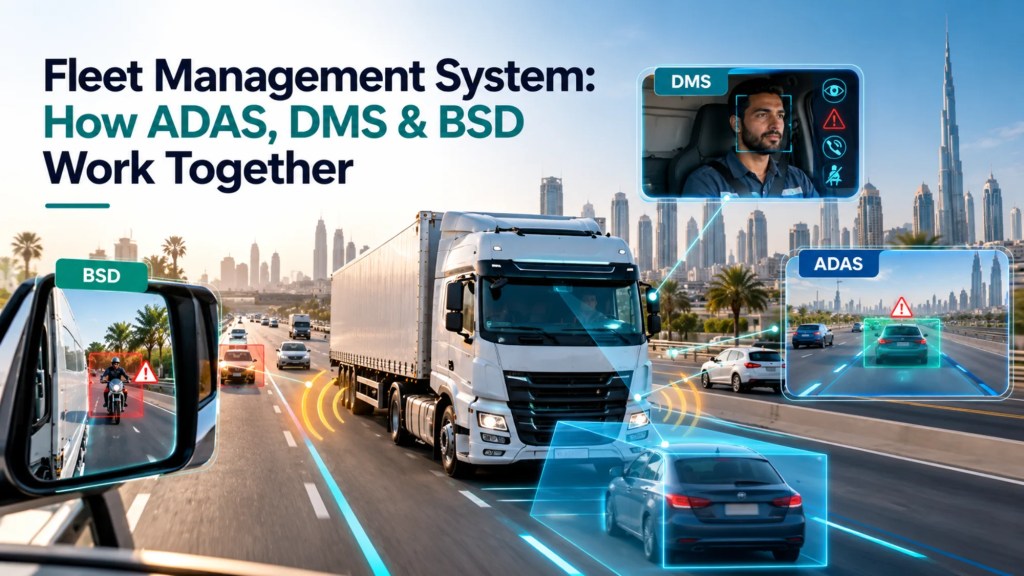
A modern Fleet Management System can combine traditional GPS visibility with video telematics to provide a clearer picture of how vehicles are being operated. This added visibility can help fleet managers understand road conditions, driver behaviour and potential risks around the vehicle.
By combining ADAS, DMS and BSD, modern fleet management can bring together information about the road, the driver and the vehicle’s surrounding environment.
ADAS, DMS and BSD address different parts of the fleet safety picture. When deployed together, they can provide a more connected view of road conditions, driver behaviour and activity around the vehicle.
Here is a deep dive into how these three pillars of telematics work independently and how integrating them can provide a more contextual approach to fleet safety.
What Role Does ADAS Play in Fleet Safety?
Advanced Driver Assistance Systems (ADAS) are designed to act as a digital co-pilot for the driver by monitoring what is happening ahead of the vehicle.
They use high-definition forward-facing cameras along with radar or LiDAR sensors to identify potential risks on the road and provide timely warnings.
ADAS can monitor several situations, including:
- Following distance: Monitors the distance between the fleet vehicle and the vehicle ahead.
- Lane departures: Detects sudden lane movement without signalling.
- Forward collisions: Identifies situations where a collision may be imminent.
- Pedestrian crossings: Detects pedestrians crossing in the vehicle’s path.
For example, if a vehicle ahead suddenly slows down, ADAS can detect the reducing distance and issue a forward collision warning. This gives the driver a timely alert about the developing hazard and can support an appropriate response.
How Does DMS Monitor Driver Behaviour?
Driver Monitoring Systems (DMS) are designed to monitor what is happening inside the vehicle cabin and provide insight into the driver’s behaviour. Unlike ADAS, which focuses on the road ahead, DMS uses specialised infrared (IR) cameras positioned around areas such as the dashboard, A-pillar or rearview mirror to monitor the driver in real time.
DMS can detect several signs and behaviours, including:
- Fatigue: Detects micro-sleeps, frequent yawning and prolonged eye closure.
- Driver distraction: Behaviours like looking down at the smartphone, eating, and smoking.
- Seatbelt compliance: Detecting that the driver is not wearing a seatbelt.
- Driver alerts: Giving an audio alert about a detected behaviour.
- Event recording: Logs detected events for review by the fleet manager after the trip.
For instance, if the driver looks down at the smartphone while driving, DMS will detect this behaviour and give an audio alert. The event will be recorded and used later by the fleet manager for coaching.
How Does BSD Reduce Blind-Spot Risk?
Blind Spot Detection (BSD) is designed to monitor areas around a commercial vehicle that may not be clearly visible to the driver. Large trucks can have significant blind spots, often referred to as “No Zones,” making visibility particularly important during lane changes and tight urban manoeuvres.
BSD can monitor these areas using side-mounted cameras or radar sensors and identify potential hazards such as:
- Vehicles: Detects vehicles entering the vehicle’s lateral blind spots.
- Cyclists: Helps identify cyclists alongside the vehicle, particularly during turning or lane changes.
- Pedestrians: Monitors blind-zone areas for pedestrians near the vehicle.
- Side and rear areas: Monitors the vehicle’s flanks and rear corners where visibility may be limited.
- Visual alerts: Provides an indication to the driver when an object enters a monitored blind zone.
For example, during a lane change, BSD can detect a vehicle or cyclist in the truck’s blind spot and provide a visual indication to the driver. This gives the driver an additional indication of what may be outside their normal field of view.

Why Integrate ADAS, DMS and BSD in a Fleet Management System?
Each technology sees a different part of the safety picture. ADAS monitors what is happening ahead, DMS provides insight into the driver’s state and behaviour, while BSD monitors areas that may be difficult for the driver to see.
Their value becomes more contextual when they work together through an AI-powered Mobile Digital Video Recorder (MDVR) platform.
A Real-World Highway Scenario
Imagine a truck travelling on a busy highway when the vehicle ahead suddenly slows down.
| Highway scenario | How the system responds |
| ADAS only: A truck is travelling on a busy highway when the vehicle ahead suddenly slows down. ADAS detects the rapidly reducing distance and issues a forward collision warning to alert the driver. | Road-focused response: The system identifies the immediate risk ahead and alerts the driver. |
| ADAS + DMS: The same situation occurs, but DMS also detects that the truck driver has been looking at a smartphone for several seconds. | Contextual response: Combining the road event with driver behaviour provides additional context and can support a higher-priority cabin alert and event review by the fleet manager. |
This combination connects an external road event with information about the driver.
Instead of treating each alert as an isolated incident, an integrated system can provide fleet managers with more context for understanding what happened and responding appropriately.
How Can Integrated Video Telematics Support Vulnerable Road Users?
Large commercial vehicles can have limited visibility around them, making pedestrians and cyclists especially important during turns and lane changes.
BSD can identify a cyclist within a blind zone, while DMS can monitor whether the driver is checking the surrounding area. Bringing these inputs together gives the fleet a clearer picture of the situation and supports a more informed safety response.
What Business Benefits Can Fleet Managers Gain?
Integrated video telematics can support fleet management beyond safety alerts by giving managers clearer evidence of incidents and useful footage for reviewing driver behaviour. It can also support more focused decisions around coaching, claims and insurance.
Key Benefits for Fleet Managers
- Incident evidence: Multi-angle video can help show what happened during an incident or disputed claim.
- Driver coaching: Recorded events can help managers address specific behaviours such as tailgating or fatigue.
- Risk visibility: Combined footage can provide a clearer view of events inside and around the vehicle.
- Insurance considerations: Video safety systems may be considered by insurers when assessing fleet risk, depending on the policy and insurer.
Conclusion: Building a More Connected Fleet Safety Approach
In today’s world, modern fleet safety is going further than just locating vehicles. A broader Fleet Management System in the UAE can bring together information about road conditions, driver behaviour and blind-spot activity through technologies such as ADAS, DMS and BSD.
At Informap Technology Center LLC, we provide GPS vehicle tracking and fleet management solutions designed to give businesses clearer visibility across their fleet operations.
Connect with us today to explore how smarter fleet visibility can support your management needs.
FAQs
1. Can video telematics help with fleet insurance?
It can form part of a fleet’s risk-management approach. However, any insurance discount or premium benefit depends on the insurer, policy and individual circumstances.
2. Can fleet video systems help with disputed accident claims?
Yes. Multi-angle video can provide footage from different viewpoints, giving fleet managers useful evidence when reviewing an incident or disputed claim.
3. How can fleet managers use video data for driver training?
Recorded safety events can help managers focus coaching on specific behaviours or incidents instead of relying only on general safety reminders.
